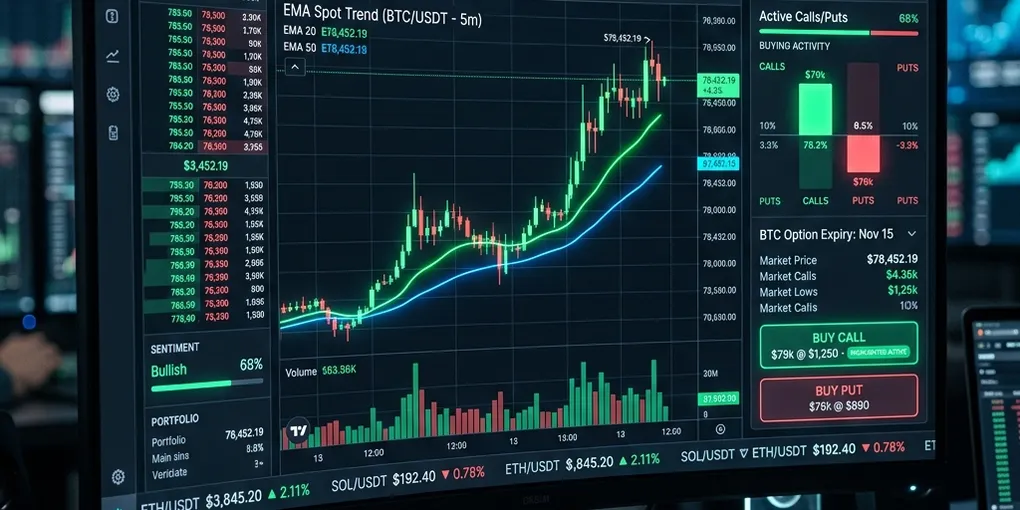
Decoding Option Buying: EMA Strategies, Spot Analysis, and Strike Selection for Consistent Gains
Decoding Option Buying: EMA Strategies, Spot Analysis, and Strike Selection for Consistent Gains
Summary
Options buying is a strategy predicated on directional conviction, betting on the future movement of an underlying asset. It is inherently a leveraged play, meaning potential returns are magnified, but so are the risks. As a quantitative analyst, I emphasize that success in options trading is not derived from a “magic indicator,” but from rigorous confluence between technical analysis, fundamental expectation, and disciplined risk management. This brief analyzes how Exponential Moving Averages (EMAs) inform entry, while dissecting the necessary mindset for charting analysis (Spot vs. Strike).
Selecting the Optimal EMA for Directional Bias
When employing EMAs for option directionality, the choice of period is critical and context-dependent. There is no single “best” EMA; rather, the optimal choice depends on the intended trade horizon.
- Short-Term Momentum (Intraday/Swing): Shorter-term EMAs (e.g., EMA 10 or EMA 20) are favored. These react more swiftly to recent price shifts, indicating immediate trend changes.
- Intermediate Trend Confirmation: The EMA 50 is often used to delineate the medium-term trend. A sustained move above or below this line provides a more robust directional bias for initiating a directional option purchase.
- Long-Term Regime Identification: The EMA 200 defines the major market regime (bullish or bearish).
Quant Caveat: Relying solely on EMA crossover signals without verifying underlying volatility (IV) and implied probability is a recipe for excessive Theta decay risk.
Spot Chart Analysis vs. Strike Chart Mechanics
The analytical framework must distinguish between the underlying asset’s movement and the derivative’s payoff structure.
- Spot Chart Analysis (Underlying Asset): This focuses on price action, volume profile, and trend identification (using EMAs). It answers the question: Is the asset likely to move up or down significantly?
- Strike Chart Analysis (Option Premium): This involves analyzing implied volatility (IV) and the Greeks ($\Delta, \Gamma, \Theta$). A trader must assess the probability of the underlying breaching key resistance/support levels relative to the chosen strike price.
For option buying, the decision is often: Does the directional conviction derived from the Spot Chart justify the premium paid, given the current implied volatility environment?
The Required Trading Mindset: Risk Quantification
The most significant differentiator between speculative gambling and quantitative trading is mindset. Option buying demands extreme discipline:
- Positional Sizing: Never allocate capital based on hope. Define maximum loss before entry.
- Theta Awareness: Recognize that time decay ($\Theta$) is your primary enemy. Trades must have a defined, aggressive time horizon where the directional move can materialize rapidly.
- Confirmation Bias Mitigation: Do not buy simply because the EMA suggests a move; wait for price action to confirm the strength of the trend, ideally through candlestick patterns or volume spikes.
Conclusion: Synthesis for Execution
Effective option buying is a synthesis: use the EMA on the Spot Chart to establish a probable direction, then use Strike Selection to define the risk/reward profile based on your conviction level. Maintain a highly objective, quantitative mindset, treating time decay as a quantifiable drag on your position.